Slide 1: Training as Optimization
Purpose: Frame the lecture as training by minimizing a loss.
- We have labeled data and want a rule that predicts future labels.
- We treat the model class as fixed and focus on training it.
- We work in 1D to keep the mechanism visible.
Slide 2: Labeled Data
Purpose: Fix the training data notation.
Formula:
\[(x_1,y_1),\ldots,(x_n,y_n)\]- Example: $x_i$ is an email and $y_i \in {0,1}$ is a spam label.
Slide 3: What Is a Model?
Purpose: Define the object we are training.
Formula:
\[m(x;w)\]- $w$ is the parameter (weights); here $w \in \mathbb{R}$.
- The same pipeline applies in higher dimensions.
Slide 4: Model Class Choices
Purpose: Separate a single model from a class of models.
- We pick a class $\mathcal{M}$ and then search inside it.
- Extreme 1: a constant model that predicts the majority label.
- Extreme 2: a large parametric family (e.g., neural nets) with architecture choices.
Slide 5: Three Questions
Purpose: Separate optimization, model selection, and generalization.
- Optimization: for a fixed model, how do we choose $w$?
- Learning: among $\mathcal{M}$, which trained model do we pick?
- Generalization: how well will the chosen model do on new data?
Slide 6: Train-Validation-Test Split
Purpose: State the standard workflow.
- Training set: fit parameters $w$ for each candidate model.
- Validation set: choose hyperparameters (step size, batch size, architecture).
- Test set: estimate out-of-sample performance of the final choice.
Slide 7: Test-Set Leakage
Purpose: Warn against treating the test set as untouchable.
- Repeatedly adapting to test performance turns it into validation.
- Kaggle-style third-party scoring still leaks signal if you iterate.
- In practice I often merge validation and test into a small holdout to maximize training data.
Slide 8: Training Loss (Empirical Risk)
Purpose: Define the objective we minimize.
Formula:
\[L(w) = \frac{1}{n}\sum_{i=1}^n \ell_i(w)\]- $\ell_i(w)$ is the per-sample loss.
Slide 9: Training Objective
Purpose: State the optimization problem.
Formula:
\[\min_{w \in \mathbb{R}} L(w)\]- Same objective as in Lecture 1; the new issue is scale.
Slide 10: Full Gradient
Purpose: Show the cost of a full-batch step.
Formula:
\[L'(w) = \frac{1}{n}\sum_{i=1}^n \ell_i'(w)\]- Computing $L’(w)$ touches all $n$ samples.
Slide 11: Why Stochastic Methods
Purpose: Motivate SGD by scale.
- The cost of a full gradient scales linearly with $n$.
- For modern language models, $n$ can be on the order of trillions.
- Even a single full gradient can be too expensive.
Slide 12: SGD Update
Purpose: State the stochastic update rule.
Formula:
\[w_{k+1} = w_k - \eta\,\ell_{i_k}'(w_k)\]- $\eta>0$ is the step size.
- $i_k$ is sampled uniformly from ${1,\ldots,n}$.
Slide 13: Sampling a Random Index (PyTorch)
Purpose: Show how to draw one sample index in code.
- Random index in ${0,1,\ldots,n-1}$.
i_k = torch.randint(low=0, high=n, size=(1,)).item()
Slide 14: Sampling a Minibatch (PyTorch)
Purpose: Show how to sample a batch with replacement.
idx = torch.randint(low=0, high=n, size=(B,))
Slide 15: Per-Step Cost
Purpose: Compare full-batch GD to SGD.
- Full-batch GD: one step costs $n$ sample gradients.
- SGD (batch size 1): one step costs 1 sample gradient.
- The key question is whether this cheaper update still makes progress.
Slide 16: Synthetic Data for the Experiment
Purpose: Define the regression dataset.
- $x_i \sim \mathrm{Unif}[-1,1]$.
- $y_i = x_i + \sigma g_i$.
- $g_i \sim \mathcal{N}(0,1)$ independent.
- $\sigma$ controls label noise.
Slide 17: Linear Model
Purpose: Fix the prediction rule.
Formula:
\[\hat y = m(x;w) = wx\]Slide 18: Per-Sample Loss
Purpose: Define the squared error.
Formula:
\[\ell_i(w) = \tfrac{1}{2}(y_i - wx_i)^2\]Slide 19: Per-Sample Derivative
Purpose: Compute the stochastic gradient.
Formula:
\[\ell_i'(w) = (wx_i - y_i)x_i\]Slide 20: SGD Update for This Problem
Purpose: Write the concrete 1D update.
Formula:
\[w_{k+1} = w_k - \eta (w_k x_{i_k} - y_{i_k}) x_{i_k}\]Slide 21: Closed-Form Minimizer (Diagnostics Only)
Purpose: Provide the reference solution for the toy problem.
Formula:
\[w^\star = \frac{\sum_{i=1}^n x_i y_i}{\sum_{i=1}^n x_i^2}\]- In real ML this closed form usually does not exist.
Slide 22: Objective Gap
Purpose: Define the diagnostic we will plot.
- Use $L(w_k)-L(w^\star)$ as the objective gap.
- This is only feasible because $w^\star$ is known here.
Slide 23: What Success Looks Like
Purpose: See the fitted line on noisy data.
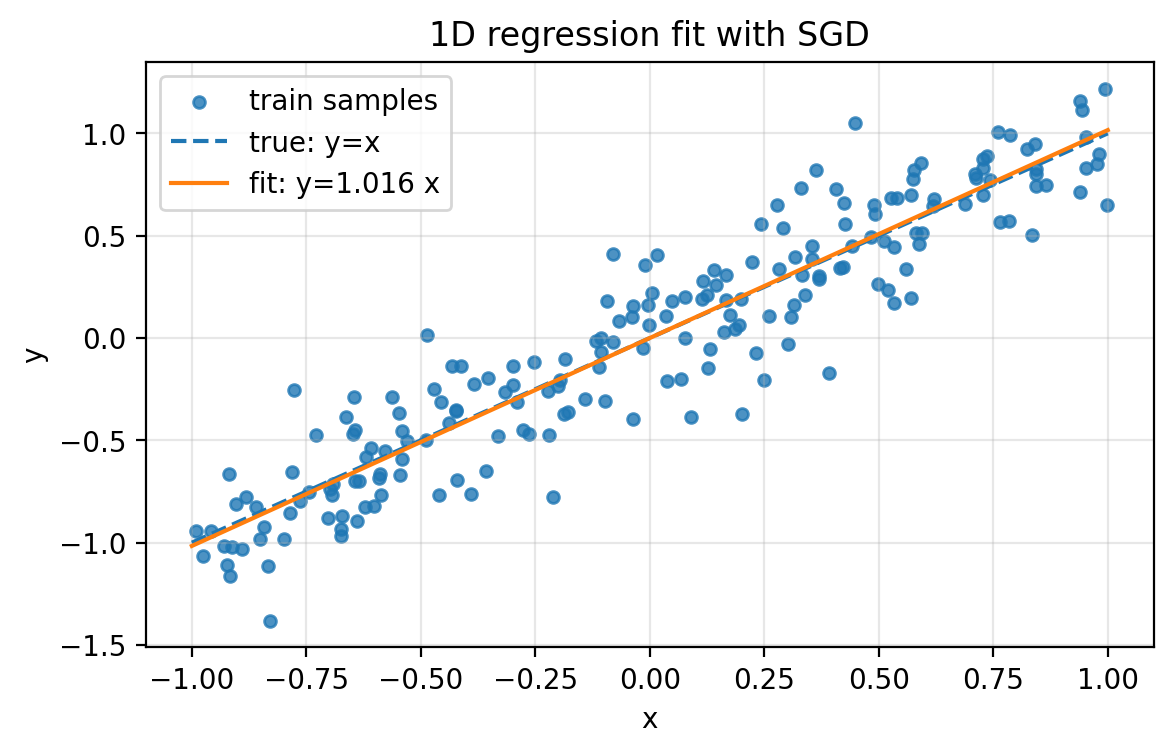 Figure 2.1.
Slide 24: Constant Step Size Behavior
Purpose: Describe the noise-floor phenomenon.
- On noisy data, the objective drops quickly then stabilizes.
- Larger $\eta$ often reduces the loss faster at first.
- Smaller $\eta$ reaches a lower noise floor.
Slide 25: Constant Step Size Tradeoff
Purpose: Visualize the noise floor across step sizes.
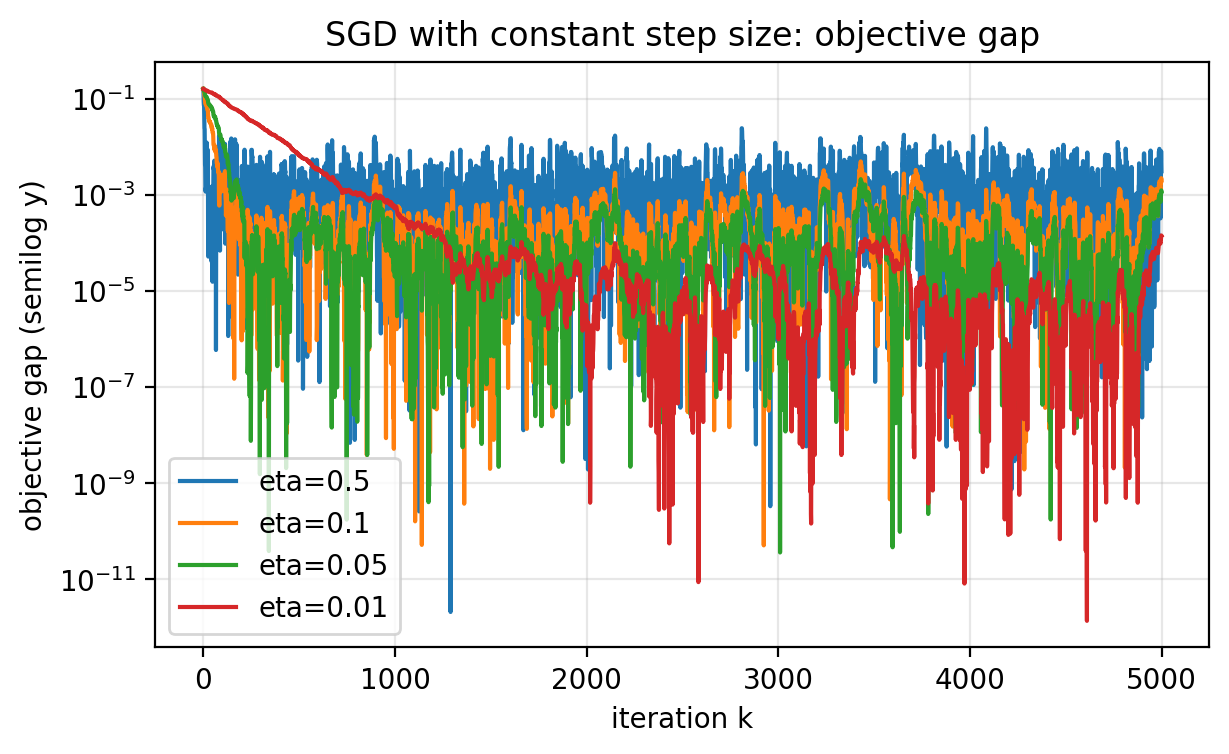 Figure 2.2.
Slide 26: What “Noise Floor” Means
Purpose: Clarify the diagnostic.
- The floor is the rough level where the curve bottoms out on average.
- You still see sharp downward jumps.
- There is no sustained downward trend beyond that level.
Slide 27: Full-Dataset Diagnostics
Purpose: Explain what we can log in the toy problem.
- Full training loss $L(w_k)$.
- Full gradient magnitude $|L’(w_k)|$.
- Use
torch.no_grad()when computing these. - At scale this is too expensive to do every step.
- You cannot detect and keep only the rare low-loss iterates.
Slide 28: Diagnostics Plot
Purpose: Show objective gap and gradient norm together.
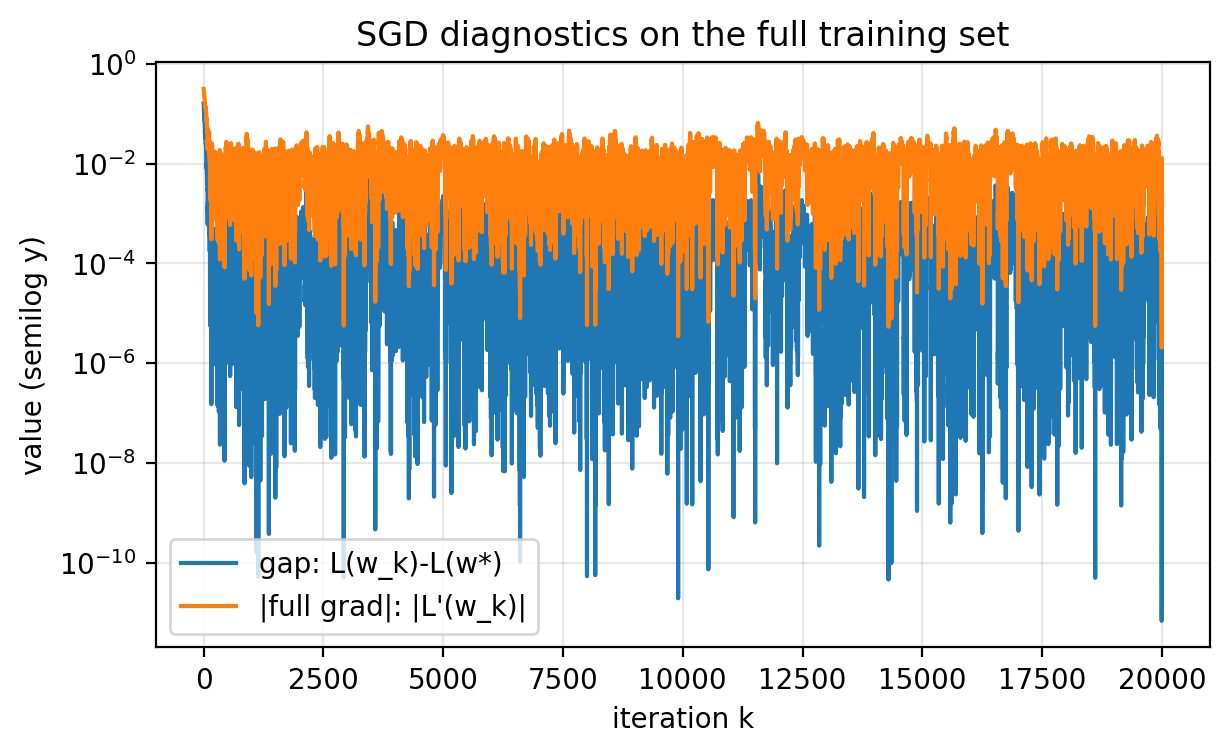 Figure 2.3.
Slide 29: Convergent Step Size Schedules
Purpose: State the classical sufficient condition.
Formula:
\[\sum_{k=0}^\infty \eta_k = \infty \quad\text{and}\quad \sum_{k=0}^\infty \eta_k^2 < \infty\]Slide 30: Power Schedule
Purpose: Give a standard schedule that satisfies the condition.
Formula:
\[\eta_k = \frac{\eta_0}{(k+1)^p} \quad\text{with}\quad p \in (\tfrac{1}{2},1]\]Slide 31: Geometric Schedule
Purpose: Give a fast-decaying alternative.
Formula:
\[\eta_k = \eta_0 \gamma^k \quad\text{with}\quad \gamma \in (0,1)\]- Often decays too quickly and progress freezes.
Slide 32: Schedule Comparison
Purpose: Compare constant, geometric, and power schedules.
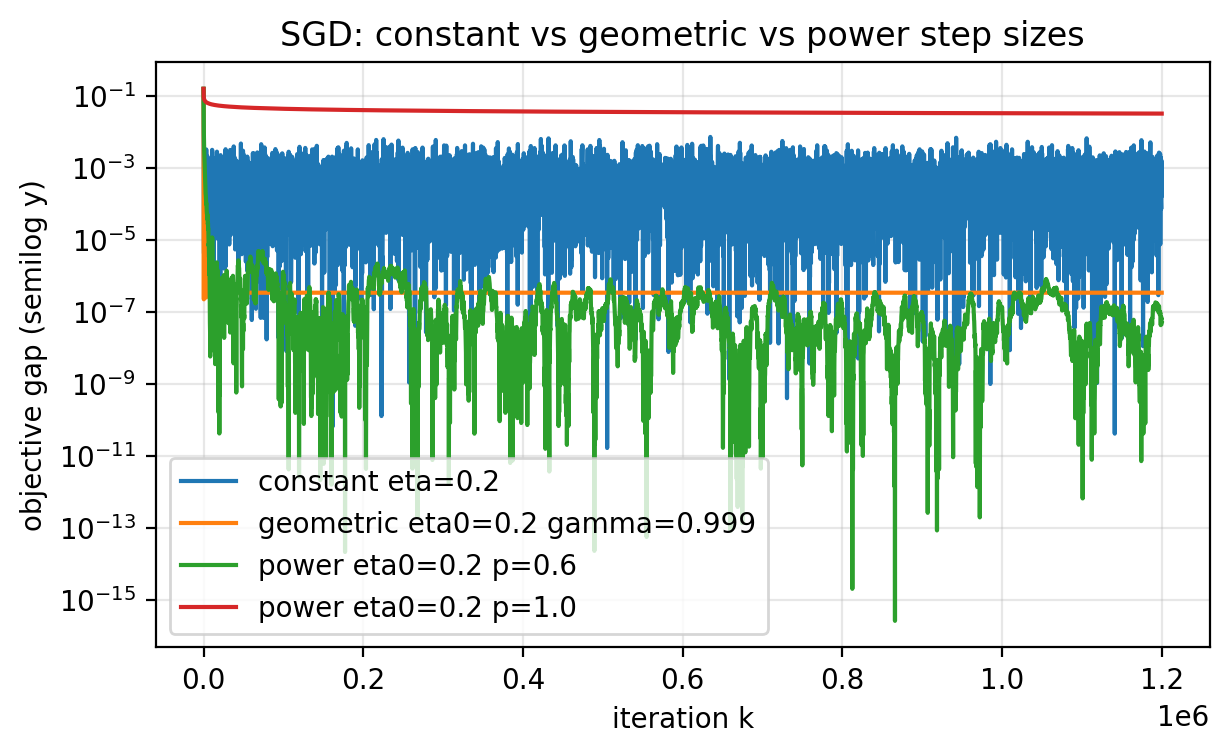 Figure 2.4.
Slide 33: Unbiased Gradient Estimate
Purpose: Explain why SGD points in the right direction on average.
Formula:
\[\mathbb{E}[X] = \frac{1}{n}\sum_{i=1}^n \ell_i'(w) = L'(w)\]- Here $X=\ell_i’(w)$ with $i$ uniform on ${1,\ldots,n}$.
Slide 34: Expected Update
Purpose: Link SGD to gradient descent in expectation.
Formula:
\[\mathbb{E}[w_{k+1}\mid w_k] = w_k - \eta L'(w_k)\]Slide 35: Variance Controls the Noise Floor
Purpose: Explain what higher label noise does.
- Larger $\sigma$ increases the variance of sample gradients.
- Same step size leads to more jitter and a higher noise floor.
- Progress toward low error slows down.
Slide 36: Effect of Label Noise
Purpose: Visualize variance effects.
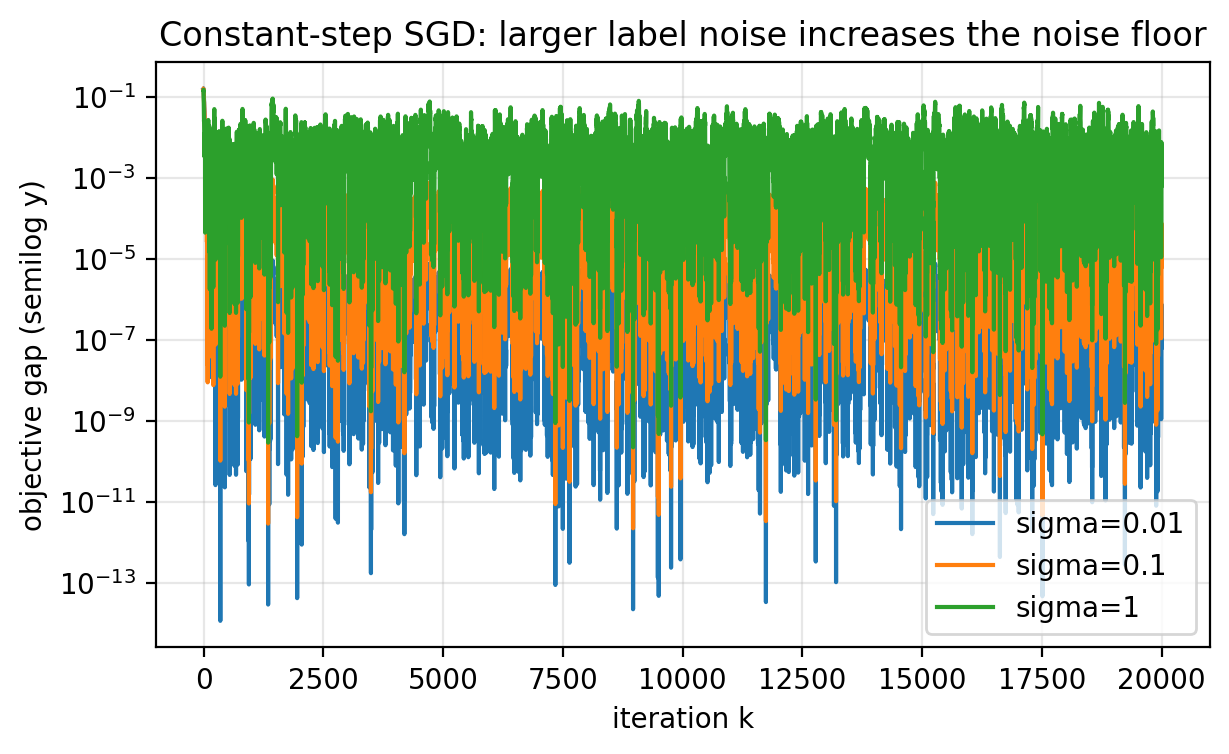 Figure 2.6.
Slide 37: Variance Reduction by Averaging
Purpose: State the basic probability fact.
Formula:
\[\mathrm{Var}\Big(\frac{1}{B}\sum_{j=1}^B X_j\Big) = \frac{1}{B}\,\mathrm{Var}(X_1)\]Slide 38: Minibatch Gradient Estimate
Purpose: Define the minibatch estimator.
Formula:
\[G_k = \frac{1}{B}\sum_{i \in B_k} \ell_i'(w_k)\]- Sample a minibatch $B_k \subset {1,\ldots,n}$ of size $B$.
- Update: $w_{k+1} = w_k - \eta G_k$.
Slide 39: Rule of Thumb for Noise
Purpose: Connect batch size and step size.
- The noise level scales like $\eta/B$.
- To match batch-1 noise, keep $\eta/B$ approximately constant.
Slide 40: Two Ways to Measure Progress
Purpose: Separate iteration count from total gradient work.
- Iterations: $k$.
- Total gradients: $kB$.
- These two views can tell different stories.
Slide 41: Minibatch vs Iterations
Purpose: Show iteration efficiency.
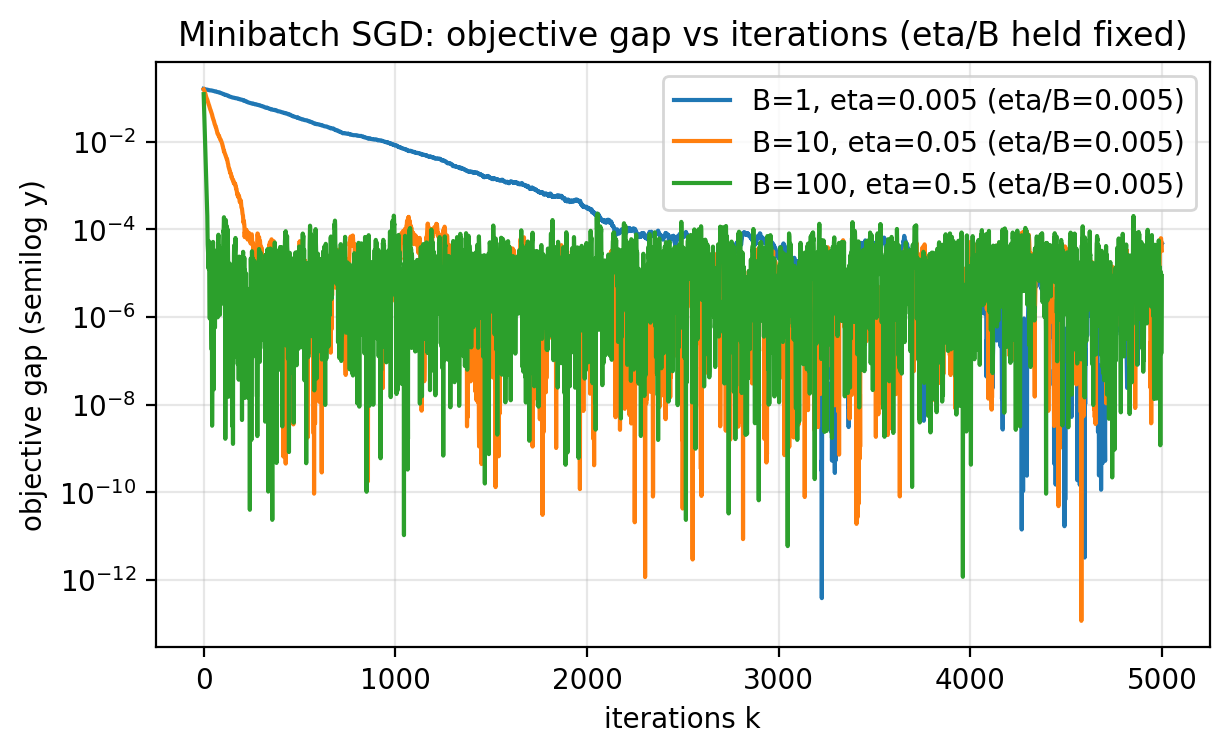 Figure 2.7.
Slide 42: Minibatch vs Total Gradients
Purpose: Compare total gradient work.
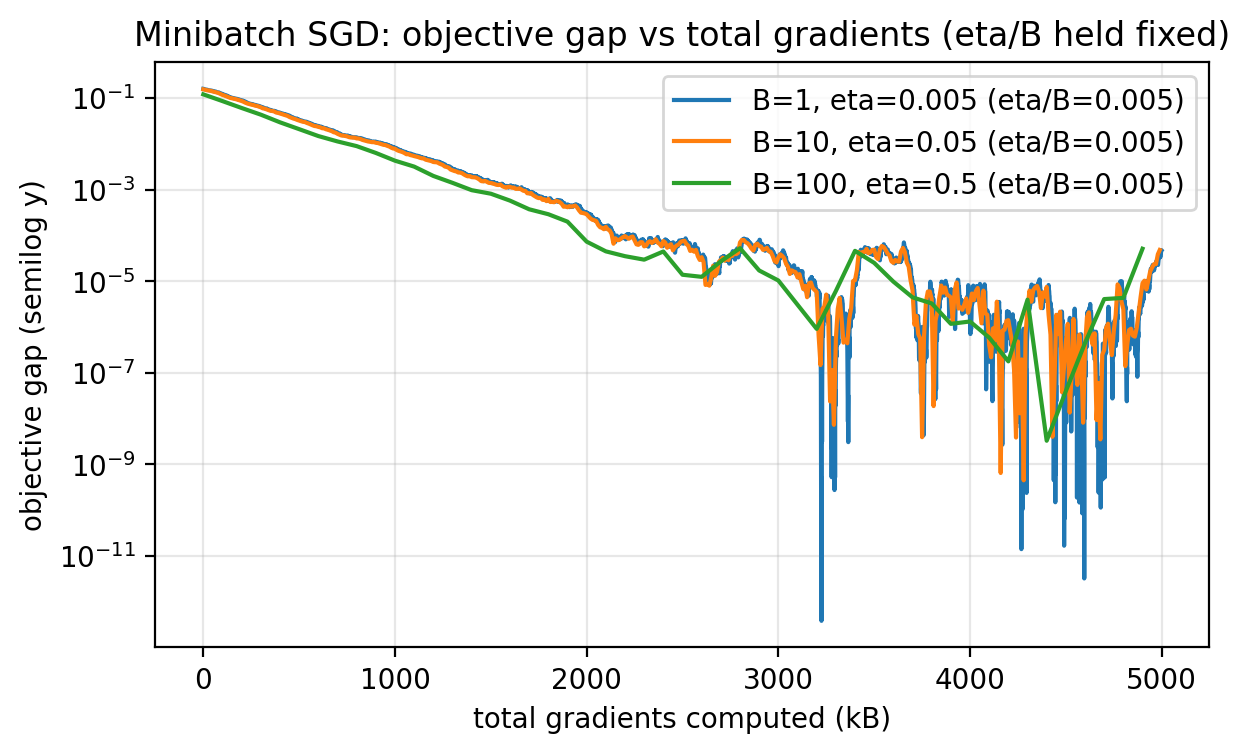 Figure 2.8.
Slide 43: Why Use Large Batches
Purpose: Motivate minibatches via parallelism.
- If $B$ gradients are computed in parallel, wall-clock time per step can stay near batch-1.
- Then fewer iterations can mean faster time-to-result.
Slide 44: When Constant Steps Are Enough
Purpose: State a clean sufficient condition.
Formula:
\[\ell_i'(w^\star)=0 \quad \text{for all } i\]- Each per-sample gradient vanishes at the optimum.
Slide 45: Noiseless Regression Example
Purpose: Show a case where the condition holds.
Formula:
\[y_i = x_i\]- Then $w^\star = 1$.
Slide 46: Per-Sample Gradients Vanish
Purpose: See why SGD becomes deterministic.
Formula:
\[\ell_i'(w) = (w-1)x_i^2\]- At $w=1$, each $\ell_i’(1)=0$.
- Even a constant step size like $\eta=0.5$ converges quickly here.
Slide 47: Noiseless vs Noisy
Purpose: Contrast the two regimes.
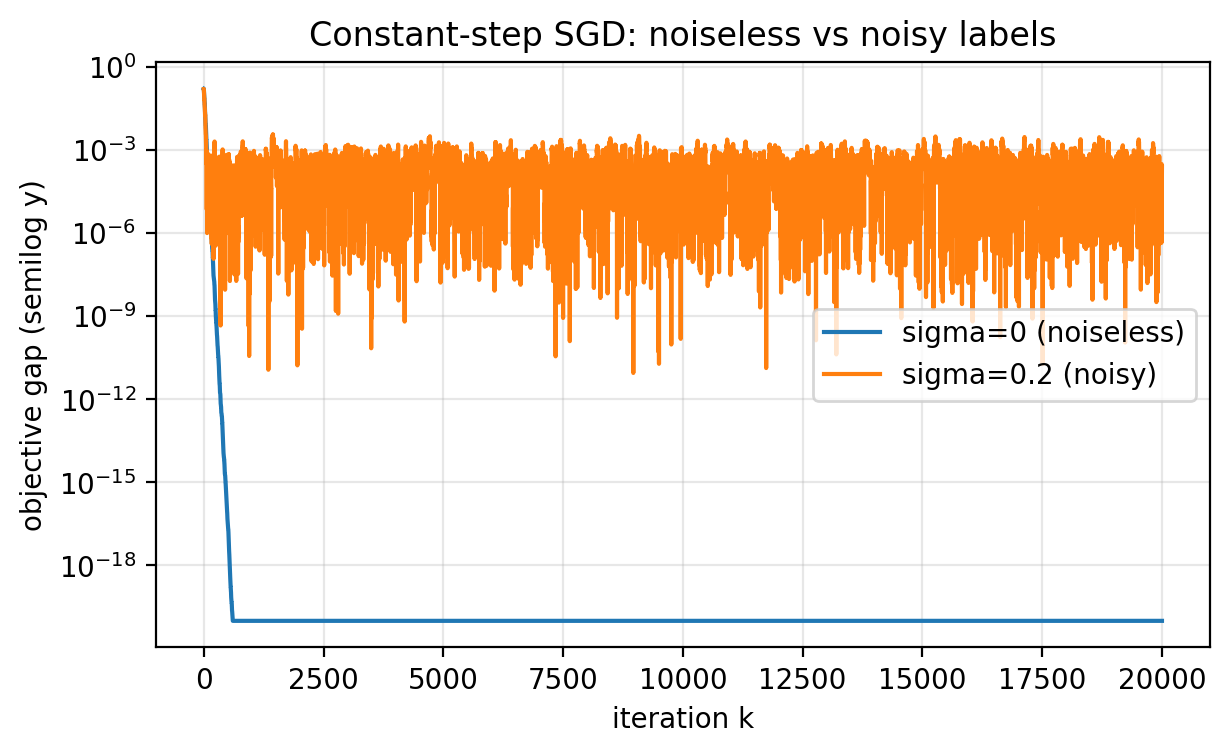 Figure 2.5.
Slide 48: Expressivity Context
Purpose: Explain when constant steps are common in practice.
- Classical ML models often cannot fit noisy data exactly.
- Deep nets can often interpolate noisy labels.
- Constant step sizes can be acceptable in highly expressive models.
Slide 49: Validation Loss
Purpose: Monitor performance on new data.
- Training loss is not the goal; we care about new inputs.
- Define $L_{\mathrm{val}}(w)$ by averaging the same loss on a validation set.
- Evaluate periodically, not every iteration.
- Use
torch.no_grad()during evaluation.
Slide 50: Validation Loop (PyTorch)
Purpose: Show the evaluation pattern.
# Assume we have training data (x_tr, y_tr) and validation data (x_va, y_va).
# Assume "step(w)" performs one SGD or minibatch-SGD update on training data.

eval_every = 200

for k in range(max_iters):
    w = step(w)

    if k % eval_every == 0:
        with torch.no_grad():
            train_loss = 0.5 * torch.mean((y_tr - w * x_tr)**2)
            val_loss = 0.5 * torch.mean((y_va - w * x_va)**2)

        print(f"k={k:6d}  train_loss={train_loss:.3e}  val_loss={val_loss:.3e}")
Slide 51: Why Monitor Validation Loss
Purpose: State what validation diagnostics are for.
- Detect divergence early (step size too large).
- Choose among hyperparameters (step size, schedule, batch size).
- Stop when validation loss plateaus.
- Validation loss is optimistic because you tune against it.
Slide 52: Conclusion: Core Points
Purpose: Capture the main takeaways.
- Training a model is empirical risk minimization.
- Full gradients cost $n$ sample gradients; SGD uses 1 per step.
- Constant-step SGD on noisy data stabilizes at a noise floor.
- Step size schedules that decrease can drive error lower but can be slow.
- Unbiasedness points in the right direction; variance makes progress noisy.
Slide 53: Conclusion: Practical Points
Purpose: Capture the practical takeaways.
- Minibatches reduce variance by averaging gradients and improve iteration efficiency.
- Fair comparisons must account for total gradient computations and parallelism.
- Diagnostics should include validation loss, not just training loss.
- These insights carry over to higher-dimensional models.